
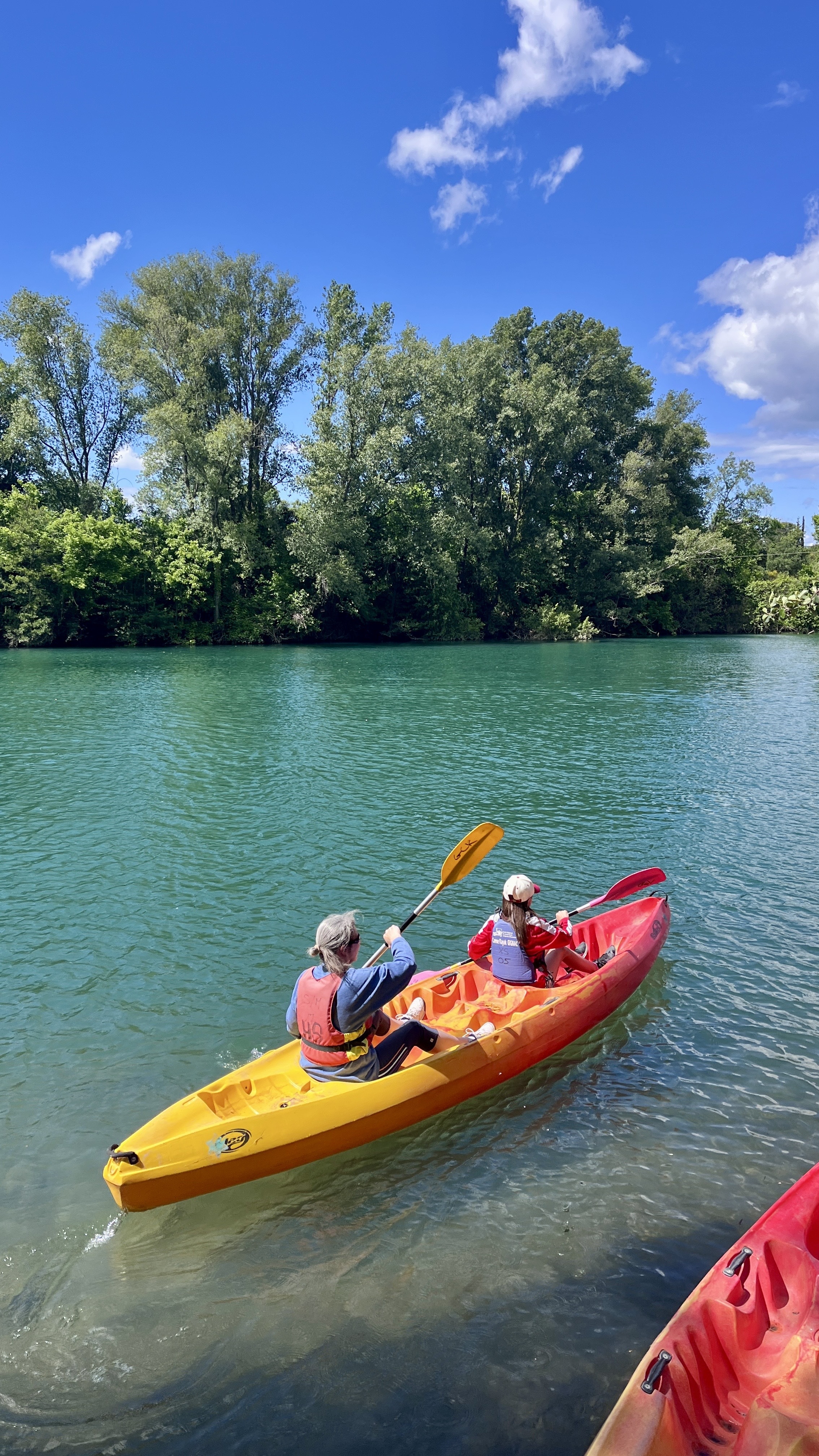
Your first paddle stroke in the emerald-green waters of the Hérault is hard to forget. The gentle resistance of the blade, the kayak beginning to glide, the reflections of trees and cliffs rippling in the current. And then, inevitably, two hundred metres later: are we actually paddling correctly?
Before we answer, let's get clear on the craft. Canoe or kayak — do you know what you've actually hired? If you're heading down the Hérault independently with us, you're in a sit-on-top kayak, not a traditional canoe. An open deck, unsinkable by design, and a double-bladed paddle — one blade on each side.
Basic vocabulary
You don't need a full nautical vocabulary before setting off. But a handful of words makes communication much easier on the water — especially when the rocks start getting closer.
The sit-on-top kayak
- Bow: the pointed front end that cuts through the current.
- Stern: the rear end — from here, the boat is steered.
- Edging: tilting the kayak to one side to lift the edge facing the current.
- Drainage holes: the openings in the deck that let water out. A sit-on-top won't sink, even when full of water — that's one of its key qualities.
- Foot pegs: the adjustable rests for your feet during each stroke. Pressing against them roughly doubles your power and stabilises your hips.
The double-bladed paddle
- Blade: the flat part that enters the water. You have two — one on each end.
- Power face: the concave side of the blade, the one that pushes water backwards.
- Shaft: the central tube you grip with both hands.
- Feather: some paddles have the two blades offset by an angle (often 45°) to reduce wind resistance. Keep your right hand fixed, and let your left hand rotate slightly with each stroke.
Safety equipment
- Buoyancy aid: compulsory, provided with your kit. It must be put on and fastened before you step into the water — not rested on your knees, not sat on, as that crushes the foam and shortens its life.
- Dry bag: for your belongings, phone, and picnic. The current gives no warning, and neither do the splashes.
How to paddle
Holding the paddle
Place your hands equally either side of the centre, slightly wider than shoulder-width apart. To find the right spacing: hold the paddle horizontally above your head — your elbows should form right angles.
Hold it loosely, not in a white-knuckle grip. It's the rotation of your torso that does the work, not your arms. A paddler who tires after fifteen minutes is paddling with their shoulders. A paddler who lasts two hours is paddling with their core.
The forward stroke: going straight
The fundamental stroke. It breaks down into three moments:
- Catch: plant the blade fully in the water as far forward as you can, keeping your back straight, front arm almost extended, shoulder driving forward.
- Pull: draw the blade back towards you by unwinding your torso. Your rear shoulder pushes forward at the same time. This double movement — pulling on one side, pushing on the other — is where the power comes from.
- Exit: lift the blade out of the water level with your hip, no further. Beyond that point, you're braking rather than propelling. Plant on the other side.
Alternate left and right at a steady rhythm. In a tandem kayak, when both paddlers are synchronised and apply equal force on each side, the kayak naturally tracks straight.
The sweep stroke: turning
To initiate a turn, one paddler makes a wide arc — from bow to stern, blade staying in the water — on the side opposite the desired direction. When both paddlers sweep on the same side at the same time, the kayak pivots decisively.
The reverse stroke: going backwards
The exact reverse of the forward stroke. Blade in the water behind the hip, push towards the bow. Useful for getting clear of an obstacle, backing out of a strong current, or repositioning before a tricky section.
The emergency stop
A rock appears, another craft crosses your path, a swimmer surfaces. Plant both blades simultaneously in the water, one on each side, and push hard towards the bow. The kayak stops sharply. Both paddlers do exactly the same thing at the same time.
Practise it in clear water at the start of the trip. It's far better to have it in your hands before you need it.
Who does what
A tandem sit-on-top kayak is as much about coordination as it is about paddling technique. Two people, one line. When roles are clear, everything flows. When they blur, you go round in circles — literally.
The front paddler: the engine
Their job: paddle steadily, with power. They set the rhythm. The rear paddler adapts to it.
- Consistent forward strokes, clean exit at the hip.
- Call out what you see: a shallow shelf ahead, a rock on the right, a faster current.
- Don't steer. Solo corrections from the front fight against the rear's corrections and send the boat into a zigzag.
The rear paddler: the helm
The rear paddler has the wider view. They see the line, the current, the obstacle twenty metres ahead that the front paddler hasn't spotted yet. They decide, the front paddler executes.
- Correct the line with subtle ruddering movements woven into the rhythm of forward strokes.
- Give short, clear instructions: "sweep left", "slow down", "stop".
- Don't wait too long to speak. An obstacle flagged too late forces sudden corrections that cost energy and upset the balance.
Synchronisation
In a double-bladed tandem kayak, both paddlers can paddle on the same side or in natural opposition — what matters is that the catch and exit of each blade are in sync between the two paddlers. That steady, maintained rhythm is what stabilises the boat and lets the rear paddler make subtle course corrections between strokes.
When synchronisation breaks down — one speeds up, the other slows — the blades start clashing and the boat yaws sideways. A simple fix: if your blades are grazing each other, reset to the front paddler's rhythm.
Common mistakes
The same mistakes come back every season, in nearly every boat. Recognising them is already half the battle.
Pulling the blade past the hip
Continuing to pull the blade beyond your hip no longer propels you — it brakes and wastes energy. Exit early, replant quickly: a short, powerful stroke beats a long, weak one.
The front paddler steering, the rear paddler losing patience
Both try to correct the line, often in opposite directions. The boat hesitates, zigzags, and opinions start flying. One pilot at a time: the rear. The front trusts the process and keeps the rhythm.
Paddling without using your feet
The foot pegs aren't there for comfort. Pressing against them during each stroke anchors your hips and lets your torso generate real power. Without that resistance, your arms tire on their own. Set the right foot peg with your legs slightly bent so you can push properly.
Not talking to each other
Silence on the water can be a genuine pleasure — it's one of the finest things about the Hérault. But coordination silence is just improvisation. Say what you're about to do before you do it. Two words is enough.
Going further
Paddling is learnt on the water, not on the page. This guide gives you a starting point — the river teaches the rest. On the Hérault, the current is gentle, the obstacles are visible, and there's no rush. You'll have plenty of time to fluff a few strokes, correct, and find your rhythm together.
If you'd like to go further — technique, more demanding rivers, or simply paddling with an instructor who can correct you in real time — our guided sessions are made for exactly that.