
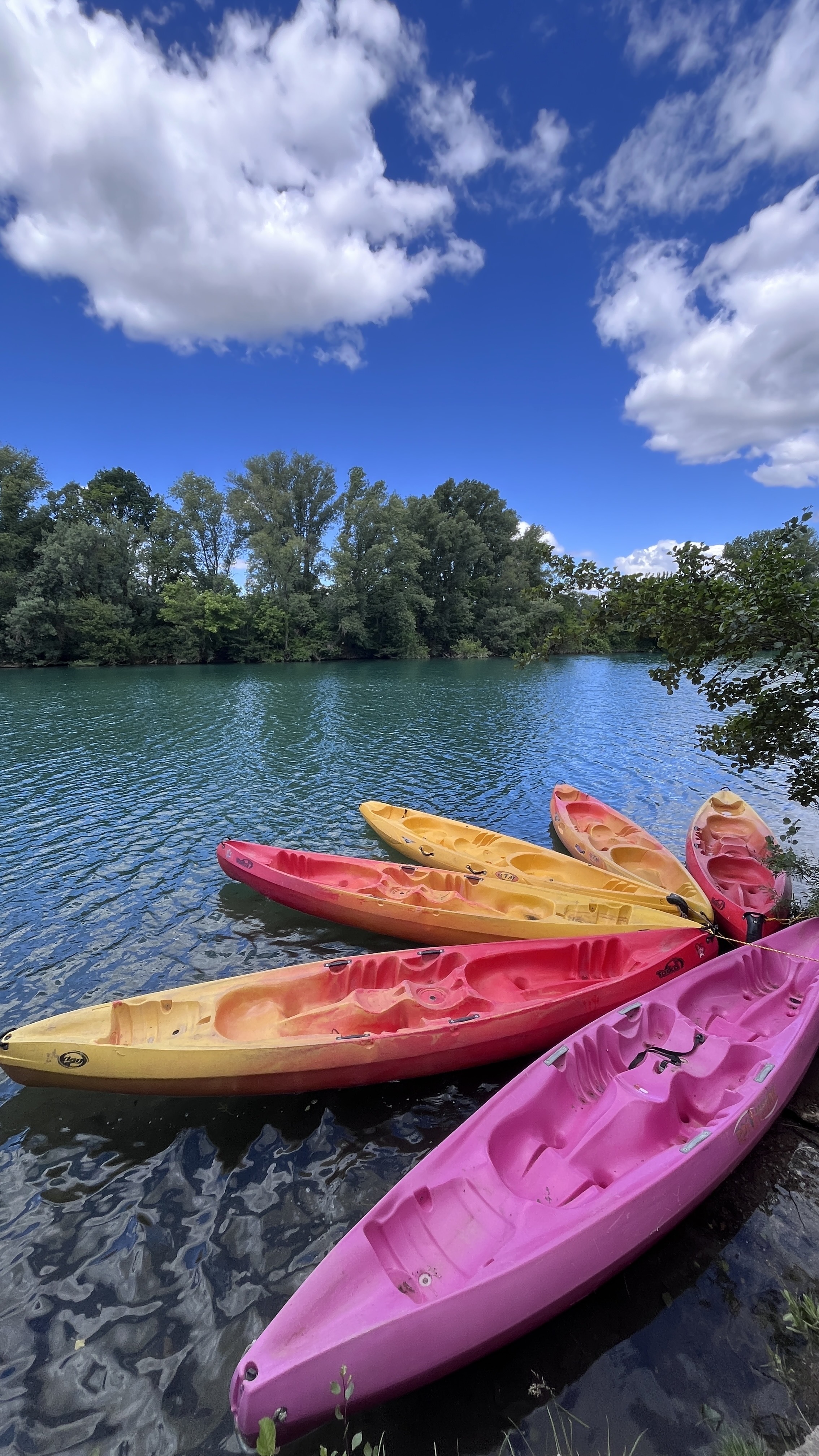
In the Hérault gorges, everyone goes canoeing. Families, couples, groups. Except that most of the time, they're actually kayaking. And we don't correct them.
In France, "canoë" has become the catch-all word for anything you paddle on fresh water. Browse any tourist brochure, any outdoor leisure website: "canoe hire". Even when it's kayaks. Even at tourist offices. Even at our base.
We own it. We say "canoe" because that's what everyone understands. If we said "come kayaking on a sit-on-top", half our visitors would picture a wetsuit and a list of fitness requirements. And because on the Hérault, both have been called "canoe trips" for forty years.
But if you're curious about what you actually did this summer — or what you're about to do — here is the real difference.
The difference that never lies
This is the most reliable test, and the easiest one to spot from the bank.
The canoe: single-bladed paddle
One blade, on one side only. You paddle alternately left and right as instructed, or on the same side using corrective strokes (the classic J-stroke). The T-grip at the top of the shaft is the giveaway.
The kayak: double-bladed paddle
A blade on each end, which you alternate left and right with every stroke. No T-grip — just a straight or slightly feathered shaft.
Golden rule: look at what's on the end of the paddle, not what's on the boat. It's the quickest way to know where you stand.
Body position
The difference in position explains a great deal about comfort, power and perceived stability.
The canoe: kneeling or on a seat
Sitting high on a canoe seat or resting on one knee, back straight, centre of gravity raised. The position feels natural to many people at first, but it becomes less stable the moment you lose focus.
The kayak: feet braced in front
Sitting low, legs stretched forward, feet resting on footrests. The lower centre of gravity makes the kayak noticeably more stable side to side. That's precisely why we offer sit-on-top kayaks for self-guided hire: they forgive beginners' mistakes far more readily.
The craft: open or closed
You'll often hear: "a canoe is open, a kayak is closed." That's partly true, but it's more nuanced than that.
The canoe: more often open
The open canoe (or Canadian canoe) does indeed have an open deck: you can see right into the hull, and load in a picnic, a dog, a child. It's spacious, sociable, practical.
But closed canoes also exist — notably the C1 and C2 used in whitewater slalom and descent. Here the paddler (always kneeling, always with a single blade) wears a spray deck covering the deck. A manoeuvrable craft built for rapids — a world away from a leisure canoe.
The kayak: more often closed
- Closed kayak (sealed deck) — the cockpit rim can accept a spray deck for whitewater or sea paddling. This is the river, descent, slalom and sea kayak.
- Sit-on-top kayak — fully open deck, no cockpit, no spray deck. You sit on top of it like a board. Very stable, unsinkable, ideal for flat water and beginners. This is the boat you see on leisure rivers all over France — on the Hérault — and that everyone calls a "canoe"!
The true defining feature of a canoe isn't whether the deck is open or closed — it's the single-bladed paddle and the kneeling or seated-on-a-thwart position.
History and origins
These two craft were not born in the same place, nor for the same purpose. You can still see that in their design today.
The canoe: a First Nations legacy
The canoe descends directly from the watercraft of North America's First Nations peoples: the Algonquin, Huron and Ojibwe. Built from birch bark, light and silent, it was the tool of transport, trade and hunting across the continent's lakes and rivers. Its open design allowed food, furs and equipment to be carried over hundreds of kilometres.
French and English coureurs des bois adopted it in the 17th century to explore Canada. The word "canoe" itself comes from the Arawak term kana:wa, via Spanish and French.
The kayak: an Inuit survival tool
The kayak comes from the Inuit and Aleut peoples of the Arctic regions of Alaska, Greenland and Canada. Built from seal skins stretched over a frame of bone or wood, it was closed around the paddler to protect them from icy waters. The spray deck ensured watertightness in the event of a capsize and enables the Eskimo roll.
Designed for individual marine hunting in extreme conditions, the kayak is fast, narrow and low on the water. Two tools, two civilisations, two oceans — and today, two families of sport united under the same roof of the FFCK.
The wider paddle sports family
The Fédération Française de Canoë-Kayak (FFCK) is far more than a canoe and kayak governing body. It actually oversees all paddle sports practised in France, from the oldest to the most recent.
Craft
- Canoe: single blade, kneeling or thwart-seated position, open or closed.
- Dragon Boat: large collective craft for 10 to 20 paddlers, paced by a drum.
- Kayak: double blade, seated position with legs extended, closed or sit-on-top.
- Outrigger canoe (Pirogue): Polynesian outrigger craft, single blade, team paddling.
- Rafting: collective inflatable craft on whitewater.
- Stand Up Paddle (SUP): standing on a board, long single blade.
Disciplines
- Sprint: pure flat-water speed.
- Wildwater: speed and river-reading on whitewater.
- Dragon Boat: timed team racing.
- Freestyle: acrobatic moves on a wave or hydraulic feature.
- Sea Kayaking: coastal or lake touring over long distances.
- Canoe Polo: team ball sport in kayaks, close to water polo.
- Ocean Racing: long-distance racing at sea.
- Open Canoe: Canadian canoe on rivers or flat water.
- Outrigger: racing in Polynesian outrigger craft.
- Rafting: team whitewater descent.
- Flat-Water Touring: long-distance paddling on rivers or lakes.
- Whitewater: technical navigation on whitewater without gates.
- Slalom: gate courses on whitewater, precision and speed.
- Stand Up Paddle: racing, touring or surfing on a board.
- Waveski: wave surfing aboard a short kayak.
Fifteen disciplines, six types of craft, one federation. What unites them: a paddle, water, and a balance to find.
What we paddle on the Hérault
Summer: self-guided hire
From May to September, our Gignac base offers two types of craft for self-guided hire:
- Sit-on-top kayak: our flagship craft for river descents. Stable, unsinkable, open to children from age 3 on the Secret Meander. This is the boat you'll call a "canoe".
- Stand Up Paddle (SUP): available for hire on the Secret Meander. Light and versatile — you can paddle it seated for extra stability or standing for a more efficient stroke. Either way, it offers a different perspective on the river.
For guided groups, our BPJEPS-qualified instructors also run discovery sessions on other craft: open canoe, Dragon Boat, Big Paddle, depending on group size and objectives.
The club: year-round on the Hérault
Outside the summer season, the club keeps paddling on the Hérault with its members. Several disciplines run side by side:
- Whitewater kayak (K1): our kayakers train on the rapids upstream and downstream of Gignac in winter, when water levels are higher.
- Sprint kayak (K1, K2): flat-water competitive paddling for members competing in French and regional championships.
- Open canoe (C2): relaxed paddling in an open canoe on flat and moving water. Open to members and offered as a discovery session for groups.
- Canoe bus (C9): group paddling in a large open canoe on flat water between Pont du Diable and Gignac. Open to members and offered as a discovery session for groups.
- Dragon Boat: the ultimate team craft, driven by the beat of a drum. Practised by our members, by the Pagaie Santé group (a gentle, regular programme suited to seniors and those in rehabilitation) on flat water between Pont du Diable and Gignac, and offered as a discovery session for companies and committees.
A breadth of offer that welcomes children from age 3 alongside seniors, beginners alongside competitors — and keeps the Hérault alive with paddling all year round.