
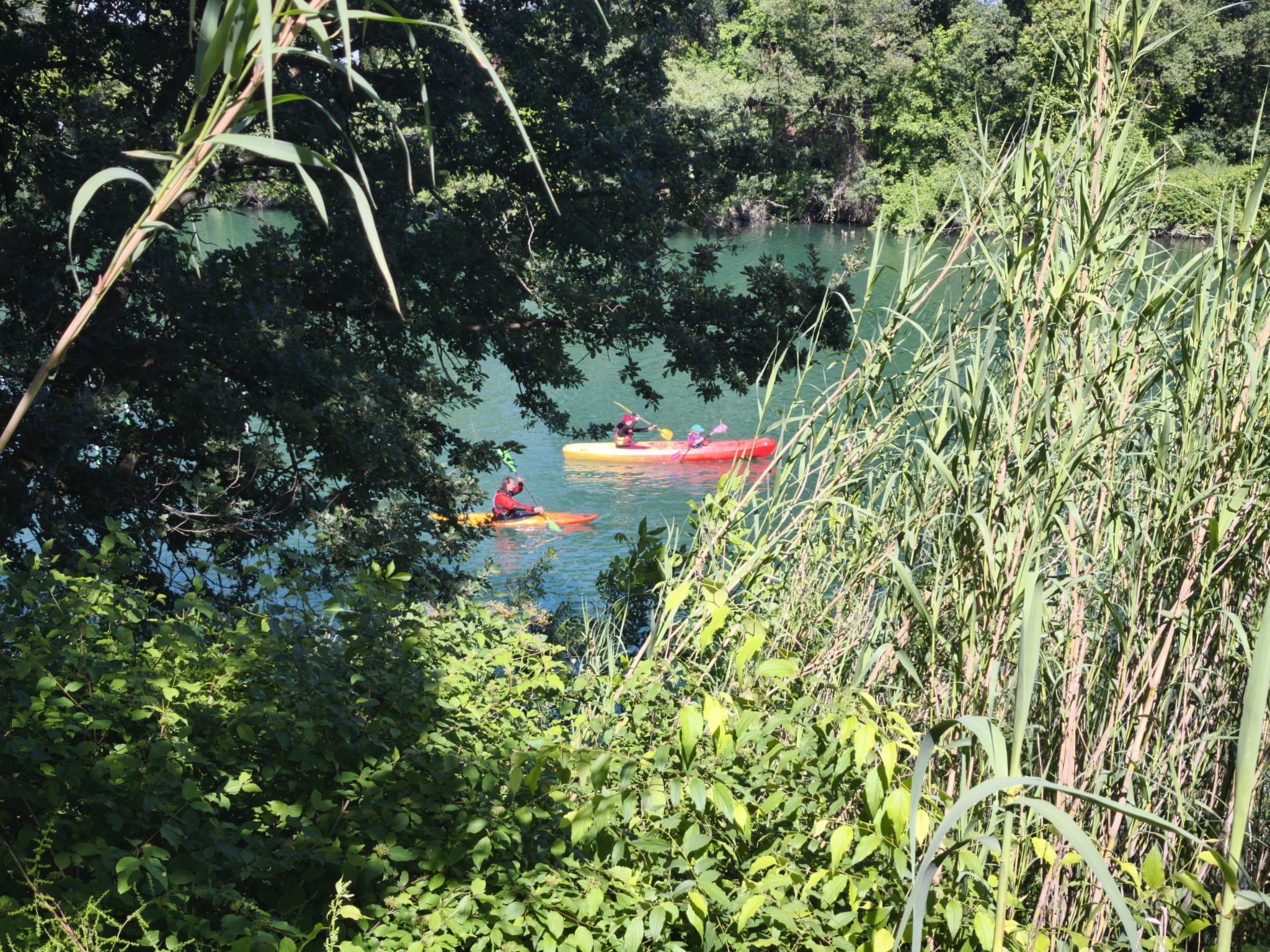
There is a science behind what you feel the moment you dip the paddle into the water and let the current carry you. This is not poetry. It is neurochemistry.
Over the past decade, a discipline has emerged: Blue Mind, theorised by marine biologist Wallace J. Nichols in his eponymous book. The argument: the human brain responds to the presence of water — seen, heard, touched, navigated — with a state of calm alertness and cognitive openness. A state between vigilance and reverie, difficult to reach by any other means.
Here is what the science says about what happens to your body and mind, hour by hour, on the water.
The first 5 minutes
The brain shifts into "water mode"
The moment you settle into the canoe and the riverbanks begin to glide past, something changes. The sight of water activates areas of the brain linked to wellbeing and reward — releasing dopamine, serotonin, and oxytocin. This is what Nichols calls Blue Mind: a calm, creative neurochemical state that water induces almost instantly.
The nervous system slows down
Within minutes, the parasympathetic nervous system overrides the sympathetic system (the one governing fight or flight). Heart rate drops, blood pressure eases slightly, the muscles of the face relax. Your body enters a mode of active recovery — before you have made the slightest physical effort.
Natural sounds erase urban noise
The lap of water, birdsong, the breath of wind through the reeds — these natural sounds, with their non-repetitive spectrum, have a measurable effect on the amygdala, the brain's fear and stress processing centre. Brain-imaging studies show that natural sounds reduce activity in the mental rumination circuit, which is closely linked to chronic anxiety.
After five minutes on the water, you have solved nothing. But your brain has already begun to breathe.
After 30 minutes
Restoring attention
Attention Restoration Theory (ART), developed by Rachel and Stephen Kaplan (University of Michigan, 1995), describes the capacity of natural environments to restore directed attention — the kind exhausted by screens, notifications, and relentless decision-making.
Water is, according to Kaplan, one of the most "fascinating" environments in the clinical sense: it captures involuntary attention (reflections, movement, shifting depths) without depleting it. In doing so, it frees up the cognitive resources needed to think clearly and to surface ideas that the daily rush suppresses.
Cortisol drops — with measurements to prove it
A study published in Frontiers in Psychology (Hunter et al., 2019) measured participants' salivary cortisol levels before and after a session in nature. The reduction in cortisol was significant after just 20 minutes of exposure — and the effects begin well before the clock reaches that threshold.
The physical benefits of paddling
Paddling is not a passive stroll. Thirty minutes of canoeing at a moderate pace engages the shoulders, arms, back, and core in a full trunk rotation. It is a gentle cardiovascular workout — roughly 200 to 250 calories — with no joint impact.
At this level of intensity, the body releases endorphins and endocannabinoids — molecules whose mood-boosting effects are similar to those of the body's own natural pain relievers. Physical effort and the aquatic environment work in synergy.
The "blue space" effect on mood
A systematic review published in Environment International (Gascon et al., 2017), covering 35 quantitative studies, concludes that regular exposure to outdoor "blue spaces" — rivers, lakes, coastline — is associated with a significant reduction in anxiety, depression, and perceived stress.
This is not the effect of physical effort alone. It is the combination of water, movement, and nature that makes the difference.
After one hour
The state of flow
Psychologist Mihaly Csikszentmihalyi described flow in his book Flow: The Psychology of Optimal Experience (1990) as a state of complete immersion in an activity, to the point where the sense of time dissolves. Canoeing — especially on a river with gentle currents and light obstacles — meets the exact conditions for flow: a challenge matched to ability, immediate feedback from the environment (the paddle responds to the water), a clear objective, and natural concentration.
In a state of flow, the brain's default mode network — the one that ruminates and anticipates — goes quiet. Anticipatory anxiety fades. What others seek through years of meditation, the water offers you naturally.
Deep stress recovery
Roger Ulrich's Stress Recovery Theory (Ulrich et al., 1991) shows that prolonged exposure to natural environments — and to water in particular — produces complete physiological recovery: normalisation of cortisol, blood pressure, heart rate, and electrodermal activity (an indicator of stress).
What begins in five minutes consolidates over an hour. And the effect remains measurable for several hours after the outing ends.
The 120-minute threshold
A landmark study published in Scientific Reports (White et al., 2019), covering nearly 20,000 people in England, established a threshold: spending at least 120 minutes a week in nature is associated with significantly better health and wellbeing than spending none at all. Below the threshold, the effect is limited. Above it, it levels off.
Two hours of canoeing a week. Not a luxury. Literally, a public health prescription.
What water really does
You do not need to be sporty, or even a strong swimmer. An hour on the water in the Gorges de l'Hérault is a natural protocol — validated by science — for offloading the nervous system, restoring attention, and returning to the world with something different in your eyes.
The river asks nothing of you except to be there. It does the rest.
References
- Wallace J. Nichols — Blue Mind, Little, Brown and Company, 2014.
- Hunter, M.R. et al. — "Urban Nature Experiences Reduce Stress in the Context of Daily Life", Frontiers in Psychology, 2019.
- Kaplan, S. — "The restorative benefits of nature: Toward an integrative framework", Journal of Environmental Psychology, 1995.
- Gascon, M. et al. — "Outdoor blue spaces, human health and well-being: A systematic review of quantitative studies", Environment International, 2017.
- Csikszentmihalyi, M. — Flow: The Psychology of Optimal Experience, Harper & Row, 1990.
- Ulrich, R.S. et al. — "Stress recovery during exposure to natural and urban environments", Journal of Environmental Psychology, 1991.
- White, M.P. et al. — "Spending at least 120 minutes a week in nature is associated with good health and wellbeing", Scientific Reports, 2019.